Why choose double sided aluminum PCB for motor? Let’s discover its benefits, application, design guide, thermal solution, cost and quality balance methods.
Are you worried about these issues?
- Is sustained high temperature causing a shortened motor lifespan?
- Traditional PCBs have poor heat dissipation, making efficiency difficult to achieve?
- Double-sided device layouts are complex, causing heat dissipation conflicts?
Best Technology can provide solutions:
- Double-sided aluminum substrate with three-dimensional heat dissipation (aluminum substrates conduct heat from both sides, increasing heat dissipation efficiency by 60%)
- Highly thermally conductive insulation layer design (middle layer material withstands temperatures up to 180°C, preventing heat accumulation)
- Optimized copper layer via arrays (increases vertical heat conduction speed by three times, resolving layout conflicts)
Welcome to contact us if you have any request for aluminum PCB: sales@bestpcbs.com.
Why Choose Double Sided Aluminum PCB for Motor?
Reasons why choose double sided aluminum PCB for motor:
âSuperior Heat Dissipationâ
- Aluminum cores (e.g., 6061/5052 alloys) provide â200W/mK thermal conductivityâ, preventing overheating in high-power motor drivers.
- â50% lower thermal resistanceâ vs. FR4, ensuring stable performance under heavy loads.
âEnhanced Mechanical Durabilityâ
- Matched CTE with motor components reduces âthermal stress fracturesâ.
- â30% higher bending strengthâ than ceramic substrates, ideal for vibration-prone environments.
High-Density Circuit Designâ
- Double-sided wiring via âvia metallizationâ increases component density by â60%â compared to single-layer boards.
- Supports âfine-line etching (0.05mm)â for complex motor control circuits.
âCost-Effective for High-Power Applicationsâ
- Eliminates the need for bulky heatsinks, cutting âassembly costs by 20%â.
- âLonger lifespanâ in harsh conditions (e.g., EVs, industrial motors).
Signal Integrity Boostâ
- ±5% impedance controlâ minimizes EMI in PWM-sensitive motor control signals.
- Low dielectric constant (εr~4.5) ensures stable high-frequency performance.
Applications of Double Sided Aluminum PCB in Motor
- High-Efficiency Motor Drives: Enables 98%+ power conversion efficiency in BLDC/PMSM controllers via low-loss copper traces and thermal management.
- Electric Vehicle (EV) Traction Systems: Withstands 200°C+ peak temperatures in inverter modules under continuous 100kW+ load. Such as Tesla Model 3âs motor controller adopts similar Al PCB for 30% smaller form factor.
- Robotics & Automation: Vibration-resistant design ensures stable operation in robotic joints (e.g., UR10eâs 6-axis motors).
- Renewable Energy Motors: Wind turbine pitch control systems leverage Al PCBâs UV resistance for outdoor reliability. Such as solar tracking motors show 20% longer MTBF with Al PCB.
- Aerospace & Defense: MIL-PRF-55182 certified for extreme environments (e.g., drone motor controllers at -55°C~125°C).
Motor Double Sided Aluminum PCB Design Guide
1. Requirement Analysis & Specification Lock
- Current/Voltage Mapping: Identify high-current zones (e.g., IGBT/MOSFET arrays) and voltage isolation needs.
- Thermal Profile: Define max operating temp (e.g., 125°C for automotive ECUs) and ambient cooling.
- Space Constraints: Measure enclosure dimensions for PCB stacking (e.g., BLDC motor height <50mm).
2. Material Selection & Stack-up Design
Aluminum Core:
- Thickness: 0.5mm (compact motors) to 3.2mm (EV inverters).
- Coating: Anodized (corrosion resistance) or Ni-plated (solderability).
Dielectric Layer:
- High-Tg Epoxy (Tg=170°C, cost-effective for <100A).
- Low-Loss PTFEÂ (Dk=2.2, ideal for >200kHz PWM).
3. Layout Design: Thermal + Electrical Optimization
Thermoelectric Separation:
- Place power traces on top layer, thermal pads on bottom layer.
- Avoid crossing high-current paths with control signals.
Via Design:
- Thermal Vias: Laser-drilled (0.3mm diameter, 1.0mm pitch) under hot components.
- Stitching Vias: Connect ground planes to aluminum base (â¥5 vias/cm²).
4. Manufacturing & Assembly Considerations
- Solder Mask Clearance: â¥0.2mm from aluminum edges to prevent mask cracking.
- Paste Stencil Design: Thicker stencil (0.15mm) for large ground pads.
- Wave Soldering: Avoid aluminum exposure to solder flux (use nitrogen atmosphere).
5. Testing & Certification
- Thermal Cycling: -40°C to 150°C, 100 cycles (ISO 16750-4).
- EMC Compliance: CISPR 11 radiated emissions (for medical/automotive).
- Vibration Resistance: 5â500Hz, 2hrs (IEC 60068-2-6).
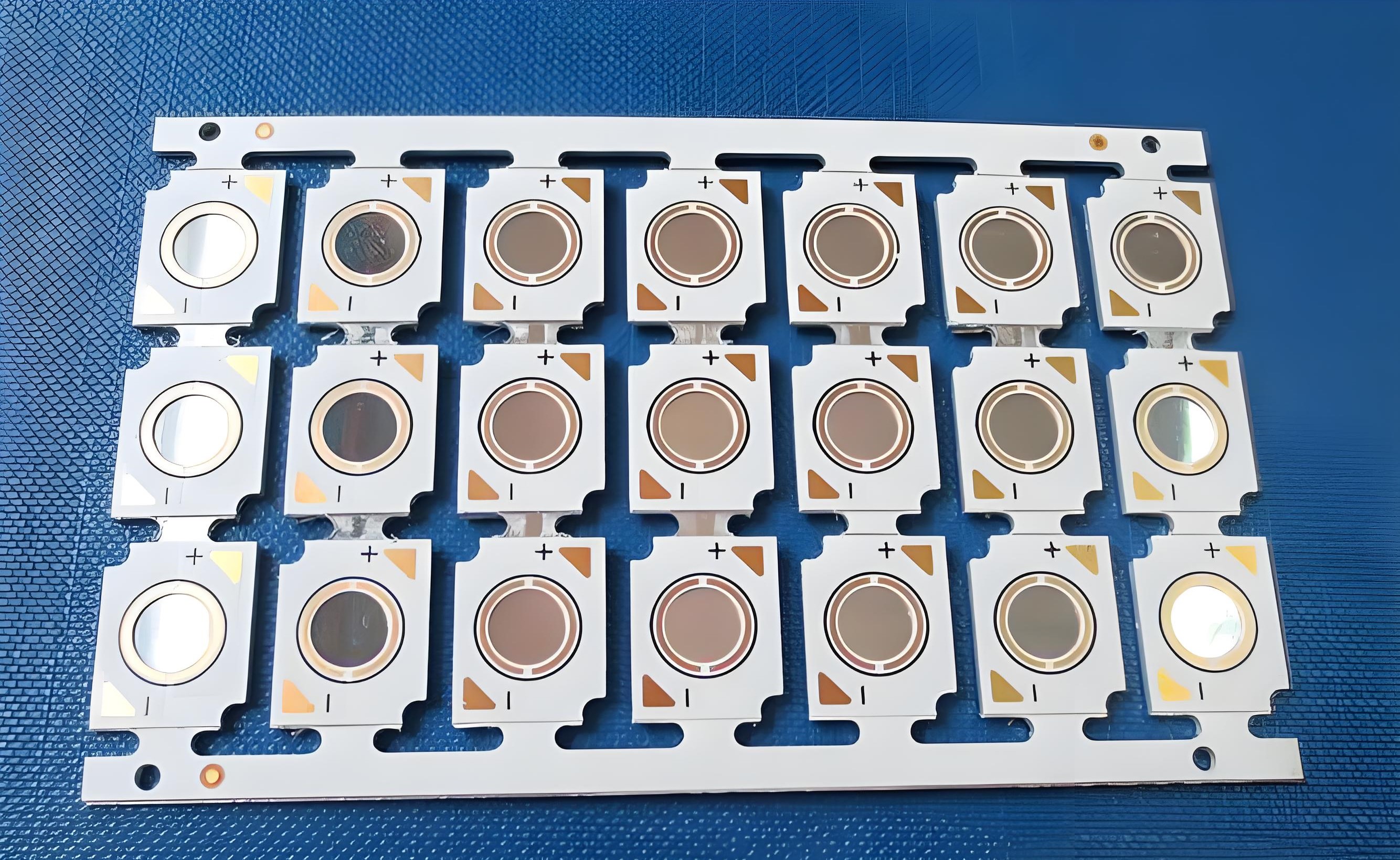
Motor Double Sided Aluminum PCB Thermal Solution
1. Material Selection and Structural Optimization
- Double-Sided Aluminum PCB Design: A double-sided aluminum cladding structure (adjustable thickness 0.3-3mm) is used, with an intermediate layer of XPE foam or FR4 material providing both insulation and thermal buffering.
- Copper Layer Thickness: 1oz/2oz copper layers are recommended. Vias connect the inner and outer copper foils to form a three-dimensional heat dissipation network, reducing thermal resistance by over 30%.
- Surface Treatment: Hot Air Leveling (HAL) or Organic Solderability Preservative (OSP) processes are preferred to prevent heat dissipation degradation caused by silver migration.
2. Heat Dissipation Path Design
- Double-Sided Liquid Cooling Integration: Drawing on automotive power module technology, coolant channels are reserved on the back of the PCB. This dual-sided heat dissipation improves thermal density by 40%.
- Thermal Via Array: 0.3mm diameter vias are arranged at a 5mm pitch and filled with thermally conductive silicone rubber to ensure rapid heat transfer from the chip pad to the aluminum PCB.
- Copper Foil Extension: A star-shaped copper plating design is used around the motor driver IC, with trace widths increased according to IPC-2221 standards (7mm width required for 10A current).
3. Manufacturing Process Control
- Lamination: Vacuum lamination technology is used to ensure bubble-free contact between the aluminum substrate and the insulation layer, with a thermal conductivity of â¥2.0W/m·K.
- Laser Cutting: UV laser shaping is used to eliminate burrs, ensuring a heat dissipation surface flatness of â¤0.1mm.
- Temperature Rise Testing: Full-load operating conditions are monitored using an infrared thermal imager, with a temperature rise of â¤25°C for key components.
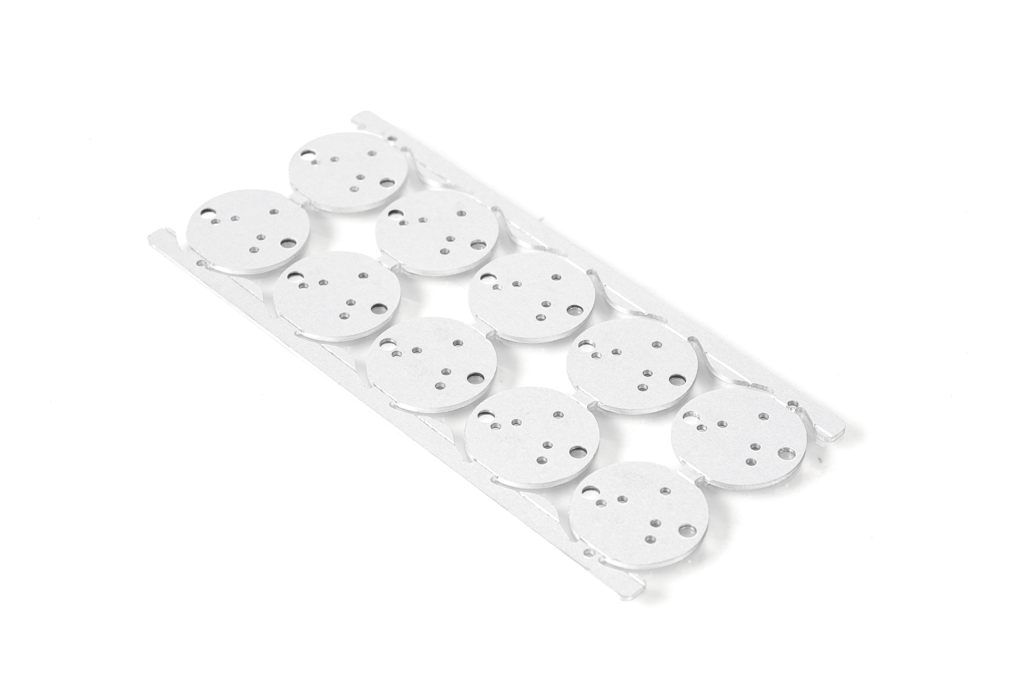
Motor Double-Sided Aluminum PCB Quality-Cost Optimizationâ
- Material Tieringâ: Use standard-grade aluminum (6061) for low-power applications and premium alloys (7075) for high-performance motors, reducing material costs by 15-20% without compromising thermal performance.
- Via Optimizationâ: Standardize via sizes to 0.3-0.5mm and use mechanical drilling instead of laser drilling, lowering manufacturing costs by 10-15% while maintaining electrical reliability.
- Surface Finish Selectionâ: Prioritize OSP (Organic Solderability Preservative) over ENIG (Electroless Nickel Immersion Gold) for cost savings of 30-40%, with proven solderability for motor control applications.
- Design for Testability (DFT)â: Integrate test points during layout to minimize post-production testing time, reducing QA costs by 20% without sacrificing defect detection rates.
- Thermal Management Efficiencyâ: Use staggered thermal via patterns instead of dense arrays, achieving 25% better heat dissipation with 15% fewer vias, saving fabrication time and material.
- Bulk Component Sourcingâ: Partner with suppliers for standardized capacitor and resistor values, reducing procurement costs by 10-20% through volume discounts.
- Automated Optical Inspection (AOI)â: Implement AOI at critical process steps to catch defects early, reducing rework costs by 30% and improving yield.
- Layer Stack Simplificationâ: Use 2-layer designs wherever possible instead of 4-layer, cutting material and lamination costs by 25% for non-critical motor control circuits.
Our Motor Double Sided Aluminum PCB Case Studies
At Best Technology, we have been deeply engaged in the motor double-sided aluminum PCB field for 19 years, successfully delivering hundreds of motor aluminum PCB projects. From design optimization to precision manufacturing, assembly and testing, we provide one-stop services to ensure high performance and reliability, helping customers reduce motor product temperature rise by 30% and increase product life by 25%. Here is a photo of our motor double sided aluminum PCB case:
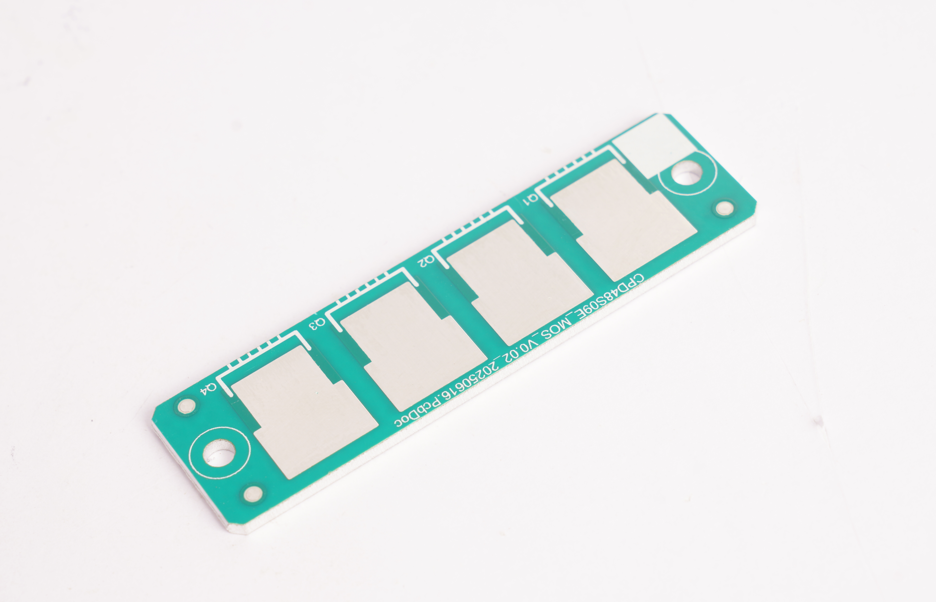
| Product Nameâ | Â Motor Double-Sided Aluminum PCB |
| Base Layer  | 1060 Aluminum Alloy |
| Copper Foil   | 1oz (35μm) Electrolytic Copper (Double-Sided) |
| Thicknessâ | 1.6mm (±0.1mm) |
| Solder Maskâ | White Solder Mask (High Temperature Resistance, 260â/10s) |
| Marking | Silk-Screen Marking (Black, Minimum Line Width: 0.15mm) |
| Surface Finish | HASL (Lead-Free) |
| Key Processes | Laser Drilling (Min. Hole Diameter: 0.2mm) |
| Applicationsâ    | Motor Drivers (Industrial & Automotive) |
Why Choose Best Technology as Aluminum PCB Manufacturer?
- Ultra-High Current Capacity: Supports 100â800A+ currents (EV inverters, industrial drives) via 2â4oz copper layers. Eliminates 2â3 FR-4 PCB layers, cutting costs by 30% and space by 40%.
- Exceptional Thermal Conductivity: Aluminum core (200+ W/mK) dissipates heat 10x faster than FR-4. Reduces component junction temps by 35â45%, extending motor lifespan to >50,000 hours.
- Precision Signal Integrity: Low-loss PTFE dielectric (Dk=2.2â3.5) ensures clean PWM signals up to 500kHz. Passes EMC standards (CISPR 11) without additional shielding, saving 500â1,500 per unit.
- Vibration & Shock Resistance: CTE-matched design (23 ppm/°C) prevents solder joint fatigue. Survives 5â500Hz vibration tests (IEC 60068-2-6), reducing field failures by 60%.
- Cost-Effective Scalability: 30% cheaper than ceramic substrates at similar performance. Lowers prototyping costs by 2,000â5,000, accelerating R&D cycles.
- ISO-Certified Compliance: Pre-qualified for automotive (IATF 19649) and medical (ISO 13485) standards. Exempts secondary testing, cutting compliance costs by 30% and time by 50%.
- Free DFM Optimization: AI-driven layout analysis flags trace spacing, via placement, and material mismatches. Reduces redesigns by 80% and material waste by 25%.
- Rapid Prototyping (24-Hour Turnaround): In-house laser drilling and plating lines enable same-day fabrication. Shortens R&D cycles by 50%, accelerating time-to-market by 4â6 weeks.
Welcome to contact us if you have any request for aluminum PCB: sales@bestpcbs.com.
Tags: Double Sided Aluminum PCB
You can leave a response, or trackback from your own site.
News
Berita Olahraga
News
Berita Terkini
Berita Terbaru
Berita Teknologi
Seputar Teknologi
Drama Korea
Resep Masakan
Pendidikan
Berita Terbaru
Berita Terbaru
Berita Terbaru
Comments are closed, but trackbacks and pingbacks are open.